
Interview by Ananya Prakash
Photography by Twin Flame Photography
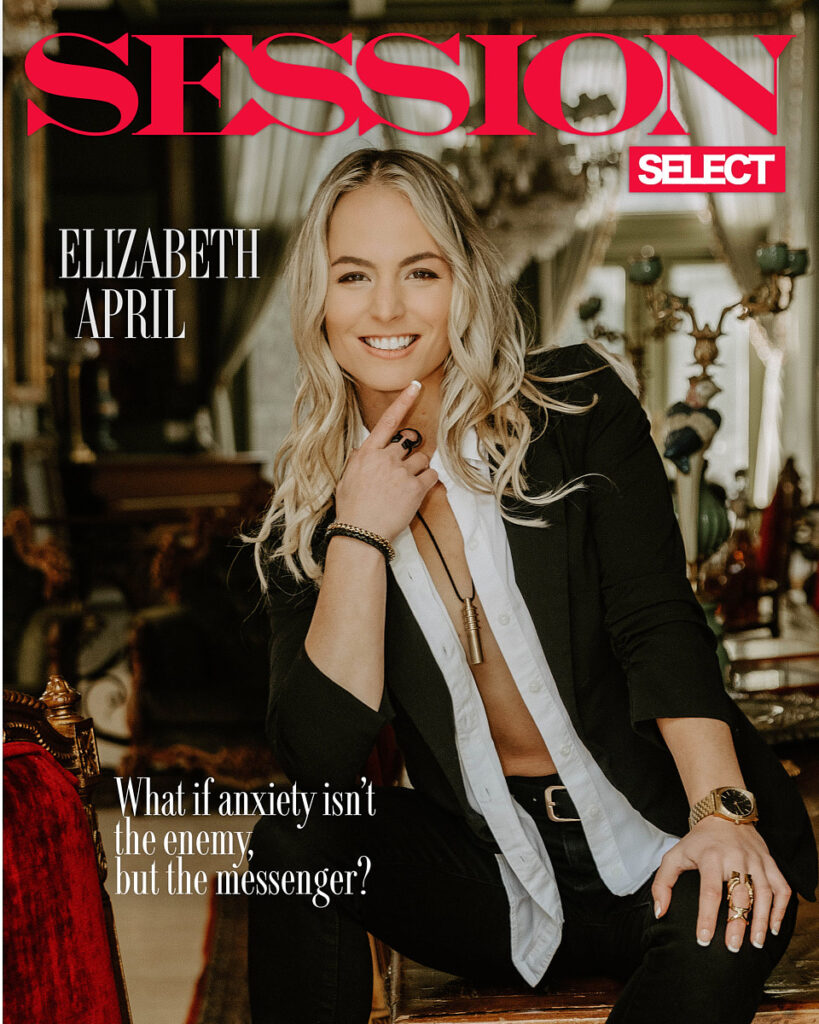
Elizabeth April is a trailblazing intuitive, cosmic channeler, and founder of the Elizabeth April School of Intuition, known for helping thousands of people awaken their psychic abilities and reclaim their inner authority. With a bold, grounded approach to spirituality, she challenges mainstream narratives and invites her community to question reality itself. In this conversation, she shares why anxiety may be an untapped superpower, how intuition can be trained like a muscle, and what it really means to step into multidimensional awareness in a rapidly shifting world.
In Your Anxiety Is Giving Me Anxiety, you describe anxiety as an “energetic alert system.” For someone steeped in traditional psychology, how would you explain that concept in a way that bridges science and spirituality?
In Your Anxiety Is Giving Me Anxiety, I describe anxiety as an “energetic alert system” because it’s not random, and it’s not a flaw. It’s your early warning signal firing before your conscious mind catches up.
Biologically, we’re wired for safety. At every level — biological and psychological — anxiety boils down to our need to feel safe. Most of the time, though, we’re not actually in danger.
So when I talk about energy, I’m not dismissing science — I’m expanding it. Our nervous system is electrical, responsive, and constantly scanning. Anxiety isn’t a malfunction; it’s an alert. I find that science explains the mechanism, but spirituality explains the meaning.
If anxiety is a signal rather than a flaw, what do you believe modern society is collectively misaligned with right now?
I believe we’re collectively misaligned with safety and emotional processing. Most of us were never taught how to regulate or process emotions. Instead, we’ve inherited generations of unprocessed trauma.
Not to mention living in a busy world with nonstop dopamine hits and endless ways to distract ourselves from our own feelings. Anxiety, in many ways, is our nervous system saying, “Something still feels unsafe.”
Add to that a global energetic shift and heightened sensitivity, and it’s no wonder anxiety is skyrocketing. We’re evolving, but we haven’t been given the tools to evolve gracefully. The biggest misalignment is that everything feels like “too much” right now. When we slow down and listen, we’re able to shift that signal from something dangerous into something helpful.

You talk about emotional and spiritual misalignment as the root of anxiety. How can someone distinguish between everyday stress and a deeper energetic imbalance?
Everyday stress feels situational. Energetic imbalance feels cumulative. In the book, I describe what I call “Oversaturated Sponge Syndrome.” Imagine absorbing emotion, trauma, and stimulation without ever wringing yourself out. That buildup becomes past-based anxiety, which feels different from present or future anxiety.
If your anxiety feels like it’s coming out of nowhere — like you’re overwhelmed even when life looks fine — you may be absorbing more than you realize. Stress is a moment. Imbalance is a pattern.
Many people feel overwhelmed by the pace of the digital age. Do you see technology amplifying energetic dysregulation — and if so, how can we protect our nervous systems?
Technology absolutely amplifies energetic dysregulation. Highly sensitive people are affected by screen time, news cycles, and constant stimulation. We are electromagnetic beings living inside an increasingly electromagnetic world. When you walk into a crowded room, your system braces for energetic influx before your mind creates a story about it.
Protecting your nervous system means actively reassuring safety. Something as simple as repeating, “I am safe,” interrupts the spiral. Pair that with intentional breathwork, and you can physiologically shift yourself out of fight-or-flight. We don’t need to escape the digital world — we need tools to regulate within it.

Your work often touches on expanded consciousness. Do you believe anxiety increases as humanity “wakes up,” or does awakening actually reduce anxiety?
I believe anxiety can increase during awakening — at first. As our collective frequency shifts, sensitivity heightens. We’re becoming more intuitive and more perceptive beyond the five senses. That can feel overwhelming if you don’t understand what’s happening. But once you learn to decode it, anxiety transforms from chaos into a compass. It becomes guidance instead of fear. Awakening doesn’t eliminate anxiety — it redefines it.
In your earlier book, You’re Not Dying, You’re Just Waking Up, you reframed fear as transformation. How has your understanding of anxiety evolved since writing that book?
With this book, I’ve gone deeper. Anxiety isn’t just transformation — it’s navigation. Anxiety isn’t trying to be silenced; it wants to be heard. It’s not the villain. It’s intuition.
The evolution for me has been understanding that we don’t conquer anxiety by eliminating it — we reclaim it by listening to it.

You’ve been featured on Unidentified with Demi Lovato and are known for your work in the UFO and alien field. How does your understanding of extraterrestrial consciousness inform your views on anxiety and human evolution?
My understanding of extraterrestrial consciousness is actually what helped me see anxiety differently. I learned through interactions with highly advanced beings that humans are energy first, physical second.
If humanity is evolving energetically, then heightened sensitivity makes sense. Anxiety may be part of that upgrade — not a glitch, but an expansion signal. The work isn’t to shut it down. The work is to stabilize as we expand.
When anxiety hits in real time — heart racing, thoughts spiraling — what is the very first step you personally take to decode the signal instead of suppressing it?
When anxiety hits me in real time, I don’t try to shut it down. I reassure safety first: “I am safe.” Then I regulate my breath. Once my body feels safe, I observe instead of react. That shift from reaction to observation changes everything.
What’s one misconception about highly sensitive or intuitive people that you wish the mainstream conversation would finally let go of?
One misconception about highly sensitive people is that they’re dramatic or fragile. Empaths simply absorb more data — emotional and energetic. If no one teaches them how to process it, they assume they’re the problem. They’re not broken. They’re perceptive.

You speak about building a resilient nervous system. Beyond meditation, what are some unexpected or unconventional practices you recommend?
Beyond meditation, one unconventional practice I recommend is daily emotional hygiene — not letting energy accumulate. Anxiety from the past builds when emotions go unresolved. Releasing energy consistently is like tidying your house before it becomes overwhelming.
Practices like cutting energy cords, sagining, using crystals, or writing a letter to burn can help release pent-up energy. Don’t wait until you’re drowning to wring out the sponge.
With over 800,000 followers and a top-ranked podcast like Expand with Elizabeth April, how do you manage the energetic weight of so many people projecting expectations onto you?
Managing the energetic weight of a large audience comes down to boundaries and awareness. I learned the hard way what happens when you feel everyone’s energy without filters — it becomes overwhelming. So I consciously separate what’s mine from what isn’t. Anxiety actually taught me how to do that.
If anxiety were a character in a movie, how would you cast it — villain, misunderstood hero, chaotic sidekick — and what would its redemption arc look like?
If anxiety were a movie character, it would absolutely be the misunderstood hero. It shows up loud and chaotic, so we cast it as the villain. But really, it’s the guide waving a red flag before we walk into something misaligned.
Its redemption arc is when we finally realize it’s not the enemy — it’s our superpower.

This interview has been edited for length and clarity.
